

The MRCP PACES exam is the clinical part of MRCP(UK): a circuit of 5 stations and 8 patient encounters, lasting 125 minutes, with two examiners at every station. You can sit it once you have passed Part 1, and you do not need to pass Part 2 Written first.
This guide covers the station format, what happens at each type of station, how marking works, eligibility, fees, international diets, centres in India and the Gulf, and when results come out.
Table of Contents
What the MRCP PACES exam is
PACES stands for Practical Assessment of Clinical Examination Skills, and it is the clinical part of MRCP(UK). Part 1 and Part 2 Written test knowledge and reasoning on screen. The MRCP PACES exam tests what you actually do with patients: how you examine, how you talk to people, and how you put findings together into a plan.
The exam is run by the Federation of the Royal Colleges of Physicians of the UK on behalf of the Royal College of Physicians (London), the Royal College of Physicians of Edinburgh and the Royal College of Physicians and Surgeons of Glasgow. You apply and manage bookings through your MyMRCP(UK) account on thefederation.uk.
If you are new to the whole qualification, our guide to what MRCP is explains how the three parts fit together.
MRCP PACES exam stations and timings
The current format has been in use since diet 3 of 2023. There are 5 stations and 8 patient encounters, and the whole circuit takes 125 minutes. You move every 20 minutes, with 5 minutes between stations.
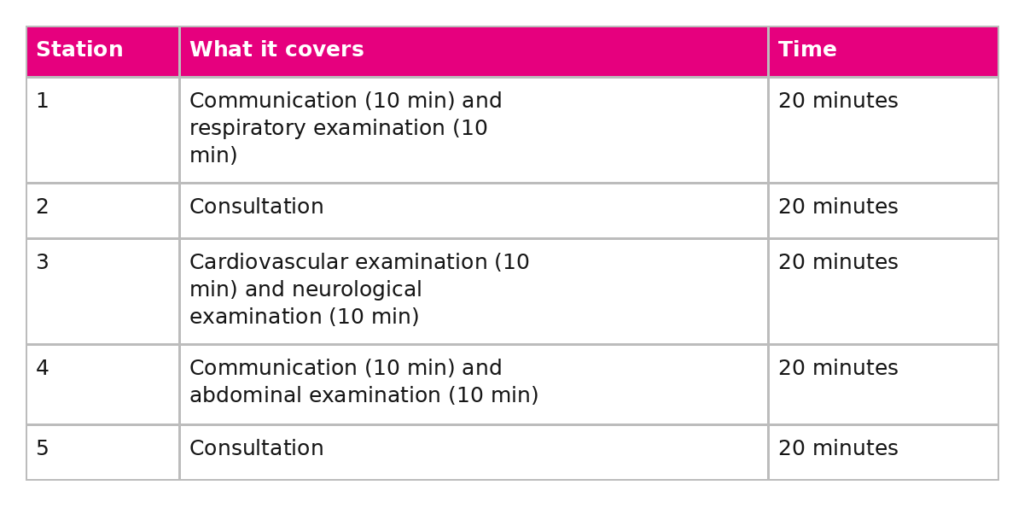
Two examiners assess you at each station. That means every encounter is seen by more than one person, which is reassuring if you worry that a single examiner might judge you harshly. The official layout is on the Federation’s PACES format page.
What happens at each type of station
The MRCP PACES exam stations fall into three types: physical examination, communication and consultation. Each asks something different of you, so it helps to think of them separately.
Examination encounters. Four of the eight encounters are physical examinations: respiratory, cardiovascular, neurological and abdominal. Each lasts 10 minutes. You typically examine a patient, present your findings and discuss them with the examiners. A fluent, practised routine is what lets you spend your thinking on the findings rather than on what to do next.
Communication encounters. Stations 1 and 4 each include a 10-minute communication task. These are typically conversations: explaining something, sharing difficult news, or discussing a decision with a patient or relative. Examiners are watching how you listen and respond, not only what you say.
Consultation stations. Stations 2 and 5 are 20-minute consultations. These typically bring the skills together in something close to a real clinic or ward review: you take a focused history, examine where relevant, explain your thinking and agree a plan with the patient. Time management matters here more than anywhere else in the circuit.
For a practical plan for each station type, read our guide to MRCP PACES preparation.
How the MRCP PACES exam is marked
The exam assesses seven skills, labelled A to G, which are listed on the Federation’s PACES page. At each encounter, every relevant skill is marked 2 for satisfactory, 1 for borderline or 0 for unsatisfactory.
The Federation sets out how marks across the circuit lead to the overall result, and its PACES page is the place to check the current standard rather than any figure you see quoted elsewhere.
What this means in practice is simple. Every encounter in the MRCP PACES exam counts, so steady, safe performance across all eight is the goal, rather than brilliance at one station and a scramble at the next.
Who can sit PACES
You can sit the MRCP PACES exam once you have passed Part 1. Part 2 Written and PACES can be taken in either order, so you do not need to wait for a Part 2 result before applying.
The regulations recommend, but do not require, two years of foundation-level training and 4 months in acute medicine before PACES. Those recommendations make sense: the exam assumes you are comfortable examining unwell patients and talking to them about real decisions.
You have a maximum of six attempts at PACES, and an exceptional additional attempt can be requested. A booked exam that you do not attend counts as an attempt. The old seven-year limit to complete all parts has been removed, so there is no time limit between parts. Our MRCP eligibility guide covers the full rules, and if you have not yet taken the written exam, see the MRCP Part 2 exam format.
Fees and international PACES diets
From diet 2026/03 the fee is £742 for UK candidates and £1,358 for international candidates at most centres. A few international centres have their own fees, so check the figure for your centre when you apply. If you pay from India or the Gulf, the local cost will be roughly whatever the exchange rate is on the day you pay.
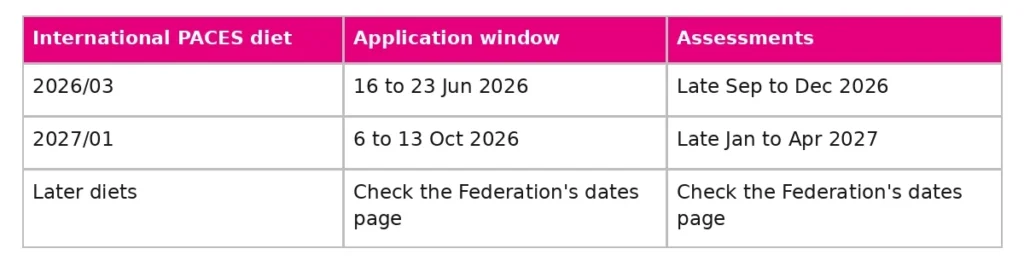
Unlike the written exams, international PACES assessments are spread over several weeks at different centres, so your actual exam day depends on where you are placed. The current figures and windows are on the Federation’s PACES dates and fees page, and our MRCP exam dates guide lists every part together.
PACES centres in India and the Gulf
For the MRCP PACES exam, India and the Gulf have a good spread of centres, though the list can change from diet to diet.
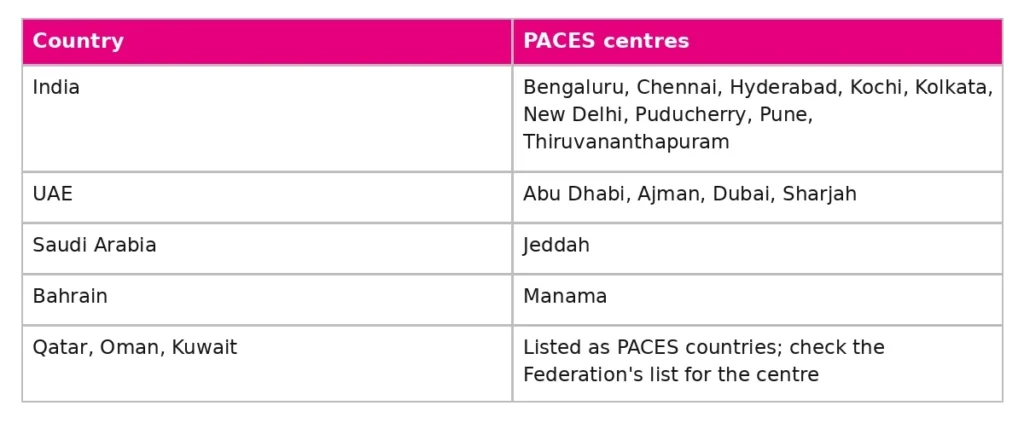
Demand has been a real issue. International PACES has had more candidates than places, and in 2023 the Federation acknowledged a waiting list. You can now choose up to four centres, so list several you can realistically travel to rather than only the closest one. The Federation explains this in its update for international PACES candidates, and the current list is on the PACES centre locations page.
When PACES results come out
International PACES candidates receive results 20 to 30 working days after the last day of assessments at their centre. UK candidates receive results within 15 working days.
Because international centres run on different days, two friends who sat the same diet in different cities may get results at different times. That is normal. Our MRCP results guide explains how to check your result in MyMRCP(UK) and what to do next.
Frequently asked questions
How many stations are in the MRCP PACES exam?
There are 5 stations with 8 patient encounters in total, lasting 125 minutes. Two examiners assess you at each station.
Do I need to pass Part 2 Written before PACES?
No. After passing Part 1, you can take Part 2 Written and PACES in either order.
How is PACES marked?
Seven skills, A to G, are assessed. Each relevant skill is marked 2 (satisfactory), 1 (borderline) or 0 (unsatisfactory) at each encounter.
How much does the MRCP PACES exam cost?
From diet 2026/03 it is £742 for UK candidates and £1,358 for international PACES candidates at most centres. Some centres have their own fees.
Where can I sit PACES in India?
Indian centres include Bengaluru, Chennai, Hyderabad, Kochi, Kolkata, New Delhi, Puducherry, Pune and Thiruvananthapuram. Check the Federation’s list when you apply, as centres can change by diet.
Why should I choose more than one centre?
International PACES demand has outstripped places, so the Federation lets you choose up to four centres. Listing several improves your flexibility.
When will I get my PACES result?
International candidates get results 20 to 30 working days after the last assessment day at their centre; UK candidates within 15 working days.
Talk to our MRCP team about choosing a diet and centres, or explore the MRCP PACES course.