
MRCP eligibility comes down to one entry rule and one order rule: you need at least 12 months’ postgraduate experience in medical employment before Part 1, and you must pass Part 1 before you can sit Part 2 Written or PACES. Once Part 1 is behind you, the other two parts can be taken in either order. You get up to six attempts at each part, and the old seven-year deadline no longer applies.
This guide covers the Part 1 entry requirement, the rules for Part 2 Written and PACES, attempt limits, the removal of the seven-year rule and the questions doctors in India and the Gulf ask us most.
Table of Contents
MRCP eligibility at a glance
The rules for the MRCP(UK) exam are set by the Federation of the Royal Colleges of Physicians of the UK, which runs the exam for the three physicians’ colleges. The current rules sit in the MRCP(UK) Regulations publishe
| Rule | What it means for you |
| Part 1 entry | At least 12 months’ postgraduate experience in medical employment |
| Order of parts | Pass Part 1 before Part 2 Written or PACES |
| Part 2 Written and PACES | Either order, once Part 1 is passed |
| PACES experience | Two years of foundation-level training and 4 months in acute medicine are recommended, not required |
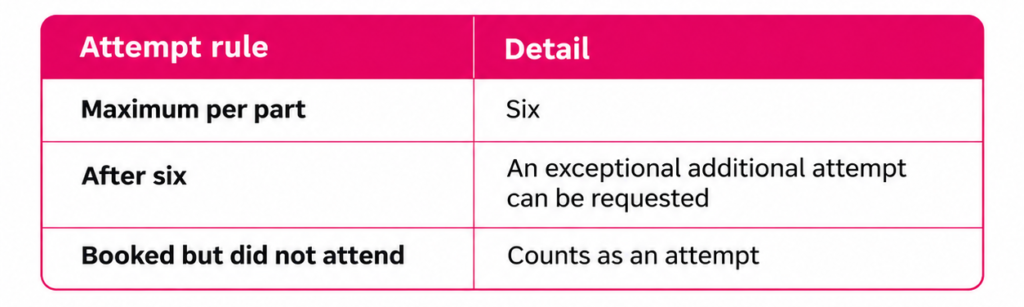
| Attempts | Maximum six at each part; an exceptional additional attempt can be requested |
| Non-attendance | Missing a booked exam counts as an attempt |
| Time limit | None. The seven-year limit has been removed |
If you are new to the exam itself, our guide to what MRCP is explains the three parts and how they fit together. The rest of this post stays on who can sit what, and when.
Part 1 entry: the 12-month rule
For Part 1, MRCP eligibility rests on a single requirement: you need at least 12 months’ postgraduate experience in medical employment. The regulations put it simply: Part 1 can be taken 12 months after graduation. That is the only entry requirement for the first part, so there is no need for a training post, a specialty job or a UK link before you apply.
The wording matters, though. “Postgraduate experience in medical employment” is the Federation’s phrase, and how your particular jobs are counted is the Federation’s decision. If your first year after qualifying was spent in a structure that looks different from a standard medical job, check how the Federation counts your experience before you book. You can do that through the Federation’s Part 1 page and the regulations linked from it.
Part 1 is two 3-hour papers of best-of-five questions, taken on computer in test centres. If you want the detail of what you will face on the day, read our guide to the MRCP Part 1 exam format.
Part 2 Written and PACES: Part 1 comes first
For the later parts, MRCP eligibility depends on one thing: Part 1 must be passed before you can enter either Part 2 Written or PACES. That is the one fixed step in the sequence. After it, the Federation lets you take Part 2 Written and PACES in either order, which gives you real flexibility in how you plan the next stage.
This is worth saying clearly because older material online, including some of our own earlier posts, said you needed Part 2 before PACES. That is not the rule. You can go straight from a Part 1 pass to PACES if your clinical skills are strong and a PACES centre suits you, then sit Part 2 Written later.
Which order is better depends on you. Doctors in busy ward jobs often feel ready for PACES sooner, while those with more desk time tend to prefer finishing the written exams first. Our PACES exam guide sets out the station format so you can judge your readiness honestly.
What the Federation recommends before PACES
For PACES, the regulations recommend two years of foundation-level training and 4 months in acute medicine. These are recommendations, not entry requirements. You will not be turned away for lacking them, provided you have passed Part 1.
The recommendation exists for a good reason. PACES tests examination, communication and consultation skills with real patients and two examiners at each station, and those skills grow with time on the wards. If you have spent most of your early years outside acute medicine, think hard about how much hands-on practice you can add before you apply.
International PACES has also had more candidates than places, and the Federation lets you choose up to four centres. Listing several centres you can travel to gives you a better chance of a seat in the diet you want. The PACES exam dates and fees page shows current application windows.
How many attempts you get
You can make a maximum of six attempts at each part of the MRCP(UK) exam. If you reach that limit, the regulations allow you to request an exceptional additional attempt; check the regulations for how requests are handled. So the limit is real, but it is not a wall you hit without warning.
One detail catches people out every year. Not attending an exam you have booked counts as an attempt. If you book and then realise you are not ready, look at the withdrawal rules on the Federation site straight away rather than simply staying at home on the day.
These rules make each sitting worth planning properly. Six attempts sounds generous, but the time and fees add up quickly, and you want every attempt to be one you were ready for. If a result has not gone your way, our guide to MRCP results walks through how to plan a resit.
The seven-year limit has gone
There is no longer any time limit for completing MRCP(UK). Under the old rules you had to pass all three parts within seven years of passing Part 1, and many doctors planned their careers around that clock. That limit has been removed in the current regulations.
In practice, this changes how you can plan. You can pass Part 1 early in your career, spend a few years building clinical experience, and come back to Part 2 Written and PACES when you are ready. There is no time limit between parts.
If you read an article or hear advice that still mentions the seven-year rule, treat it as out of date. The Federation’s MRCP(UK) Regulations (February 2026) are the document to rely on.
MRCP eligibility for doctors in India and the Gulf
The same regulations apply wherever you sit the exam. What differs is the practical side, such as where you sit each part and how you show your experience. Fees also differ, with a UK fee and a higher international fee for each part.
For the written parts, India has centres in Chennai, Hyderabad, Kerala, Kolkata, Mumbai and New Delhi. In the Gulf there are written centres in Abu Dhabi, Dubai, Doha, Jeddah, Riyadh, Muscat, Kuwait City and Manama. PACES centres are a separate list and can change by diet, so check them each time you apply against the same eligibility rules. Our MRCP exam dates guide keeps the current diets and application windows in one place.
You apply and manage bookings through your MyMRCP(UK) account on thefederation.uk. Set it up well before an application window opens, and keep your qualification and employment details ready so you are not scrambling on the day bookings open.
Once you are sure of your MRCP eligibility, the next step is preparation. Many doctors sit Part 1 while working full time. If that is you, our MRCP Part 1 preparation guide has study plans built around shift work, and the MRCP Part 1 course gives you structured teaching and question practice under Dr Suman Paul’s direction.
Frequently asked questions
Does my internship count towards MRCP eligibility?
Part 1 needs at least 12 months’ postgraduate experience in medical employment, and the Federation decides how each candidate’s experience is counted. Check how the Federation counts your experience on its Part 1 page or with the Federation directly before you book.
Can I take PACES before Part 2 Written?
Yes. Under the current eligibility rules, once you have passed Part 1, Part 2 Written and PACES can be taken in either order.
Do I need to work in the UK to be eligible?
No. MRCP eligibility does not depend on UK experience, and Part 1, Part 2 Written and PACES are all offered at international centres, including in India and the Gulf.
How many times can I attempt each part?
Up to six times per part. An exceptional additional attempt can be requested after that, and missing a booked exam counts as one of your attempts.
Is there still a seven-year limit after passing Part 1?
No. The seven-year limit has been removed from MRCP eligibility, and there is now no time limit between parts.
Are the PACES experience requirements compulsory?
No. Two years of foundation-level training and 4 months in acute medicine are recommended before PACES, but they are not required. A Part 1 pass is the requirement.
Talk to our MRCP team if you are unsure where you stand on MRCP eligibility or which part to plan next.
Related guides:
- What is MRCP? The MRCP(UK) exam explained
- MRCP exam dates for Part 1, Part 2 and PACES
- MRCP Part 1 exam format
- MRCP vs PLAB: which route suits you