

MRCP after MBBS is a realistic plan for Indian doctors: you can sit Part 1 once you have 12 months’ postgraduate experience in medical employment, and the later parts follow at your own pace. It is a UK membership exam, not a replacement for MD or DNB in India, so it works best when you know whether you want to practise abroad, in India, or keep both doors open.
This guide covers eligibility, how MRCP compares with MD and DNB General Medicine, doing it alongside NEET-PG or residency, centres in India, costs and where our clinical programme fits.
Table of Contents
What MRCP UK means for an Indian MBBS graduate
MRCP UK, written formally as MRCP(UK), is the Membership of the Royal Colleges of Physicians of the United Kingdom. It is run by the Federation of the Royal Colleges of Physicians of the UK on behalf of the Royal College of Physicians (London), the Royal College of Physicians of Edinburgh and the Royal College of Physicians and Surgeons of Glasgow. “MRCP” is also the name of an MRI scan of the bile ducts, so when you search, look for MRCP(UK) to be sure you are reading about the exam.
There are three parts: Part 1, Part 2 Written and PACES, a clinical exam with real patients. In the UK, MRCP(UK) is the membership exam physicians take during internal medicine training. For you, that means the standard is set for practising physicians, not final-year students. Our overview of what MRCP is explains each part in more detail.
When can you start MRCP after MBBS?
You can sit Part 1 once you have at least 12 months’ postgraduate experience in medical employment. The regulations put it as Part 1 being open 12 months after graduation. Whether your internship year counts towards that is something to confirm yourself: check how the Federation counts your experience before you book.
After Part 1, the order is flexible. Part 2 Written and PACES both need a Part 1 pass, and you can take them in either order. For PACES, two years of foundation-level training and 4 months in acute medicine are recommended, not required. The full rules sit on our MRCP eligibility page.
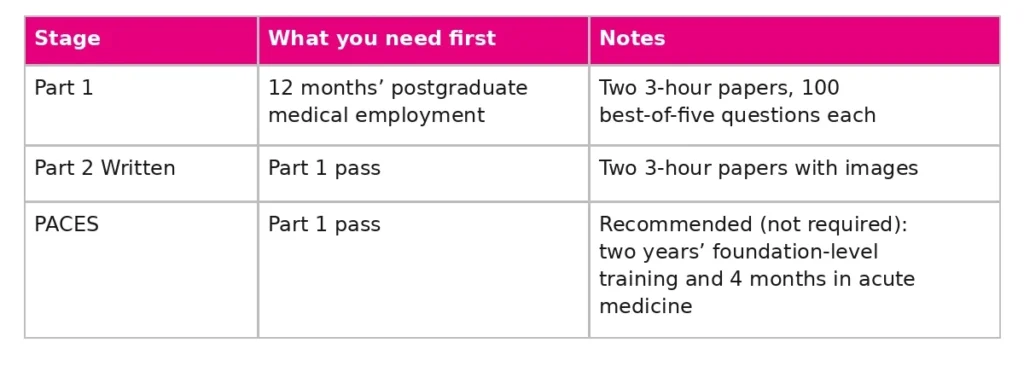
You get a maximum of six attempts at each part, and missing a booked exam counts as one. The old seven-year limit has been removed, so there is no time limit between parts.
MRCP vs MD and DNB General Medicine
The biggest question with MRCP after MBBS is how it sits next to an Indian postgraduate degree. MD General Medicine and DNB General Medicine are Indian qualifications: seats come through NEET-PG counselling, and you complete a three-year residency with a final exam. MD is awarded by universities and DNB by NBEMS.
MRCP(UK) works differently. You sit exams, not a residency, and the qualification comes from the UK royal colleges. Under the National Medical Commission, UK royal college memberships are not equivalent to MD or DNB. For medical college faculty posts, UK qualifications count only with CCT or CCST plus UK specialist registration.
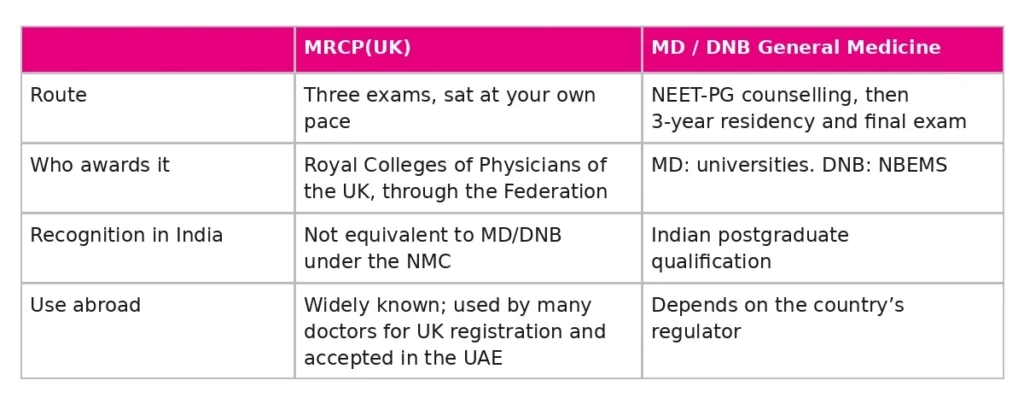
So which is better? Neither, in the abstract: if you want to teach in an Indian medical college, the NMC rules point to MD or DNB. If you aim for the UK or the UAE, MRCP(UK) is often the more direct qualification; for other Gulf countries, check the regulator. Many doctors end up with both.
Doing MRCP alongside NEET-PG or residency
MRCP after MBBS does not have to compete with NEET-PG. There is overlap with the core medicine you revise for NEET-PG, though the question style differs. The best-of-five format rewards clinical reasoning more than fact recall.
During residency, the picture changes. Your ward work in general medicine is excellent PACES preparation: you examine patients, take histories and explain plans every day. The hard part is time. Many residents find it easier to pick one part per diet and protect a few hours most days, rather than trying to cram around night shifts.
A common pattern for MRCP after MBBS looks like this. Sit Part 1 once you meet the 12-month rule (check how the Federation counts your internship), take Part 2 Written mid-residency, then PACES once your clinical skills are sharp. The later two parts can be taken in either order. Because there is no time limit between parts any more, you can pause during a heavy rotation and pick up later.
Exam centres in India
You don’t need to travel abroad for most of the exam. Part 1 and Part 2 Written are computer-based exams held in test centres, and the Federation lists Chennai, Hyderabad, Kerala, Kolkata, Mumbai and New Delhi as written centres in India.
PACES centres in India include Bengaluru, Chennai, Hyderabad, Kochi, Kolkata, New Delhi, Puducherry, Pune and Thiruvananthapuram. International PACES has had more candidates than places, and the Federation lets you choose up to four centres, so list several you can reach. Centres can change by diet, so check the current list on the Federation’s centres page when you apply, and see our MRCP exam dates guide for the next diets.
What MRCP after MBBS costs
Fees are set in pounds, which is worth knowing early if you are budgeting for MRCP(UK) from India. Each part has a UK fee and an international fee, and you can check which applies to you on the Federation’s dates and fees pages.
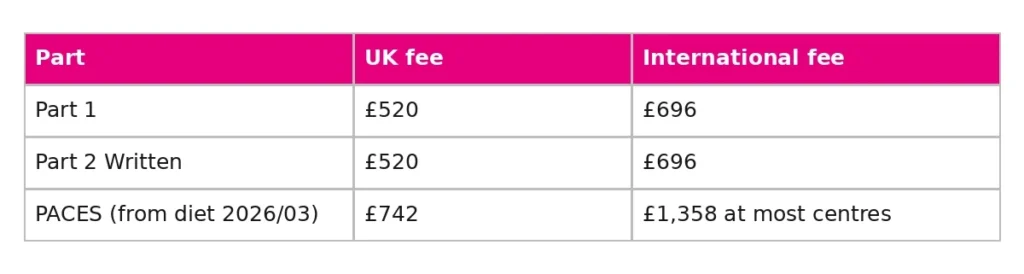
In rupees the cost moves with the exchange rate, so work it out roughly, at the exchange rate on the day you pay. Add your study materials, any course you join and travel to a PACES centre. Budget for the possibility of a resit too, without planning on one.
Is MRCP after MBBS the right choice for you?
It is a good fit if you want an internationally known physician qualification and can study steadily while working. It is a poor fit if your only goal is a faculty post in India, because the NMC rules point you to MD or DNB for that.
Ask yourself three questions: where do you want to practise in five years, can you give regular hours each week for several months per part, and are you comfortable with a self-paced route instead of a structured residency? If the answers lean abroad, MRCP is worth serious thought. Our guide to career after MRCP looks at the UK, India and the Gulf in turn.
If you want hospital experience while you prepare, StudyMEDIC’s clinical programme in internal medicine includes MRCP training. For exam teaching, start with our MRCP Part 1 course.
Frequently asked questions
Can I take MRCP Part 1 straight after MBBS?
You need at least 12 months’ postgraduate experience in medical employment first. Check how the Federation counts your experience, including your internship, before you apply.
Is MRCP equivalent to MD in India?
No. Under the NMC, UK royal college memberships are not equivalent to MD or DNB, and for faculty posts UK qualifications count only with CCT or CCST plus UK specialist registration.
Can I prepare for NEET-PG and MRCP Part 1 together?
Many doctors do, because both draw on core medicine. The question styles differ, so practise best-of-five questions specifically for MRCP.
Do I have to pass Part 2 before PACES?
No. After passing Part 1 you can take Part 2 Written and PACES in either order.
Where can I sit MRCP in India?
Written exams are held in Chennai, Hyderabad, Kerala, Kolkata, Mumbai and New Delhi. PACES centres include Bengaluru, Chennai, Hyderabad, Kochi, Kolkata, New Delhi, Puducherry, Pune and Thiruvananthapuram.
How much does MRCP after MBBS cost in rupees?
Fees are in pounds, for example £696 for Part 1 at the international fee. Convert roughly, at the exchange rate on the day you pay.
Is there a time limit to finish all three parts?
No. The previous seven-year limit was removed, so there is no time limit between parts, though each part has a maximum of six attempts.
Talk to our MRCP team about the right time to start and which part to take first.
Related guides:
- What is MRCP: the exam explained
- MRCP eligibility rules
- Career after MRCP in the UK, India and the Gulf
- MRCP vs PLAB for a UK career