
Your career after MRCP depends mostly on where you want to work: in the UK the qualification can support GMC registration and a move into hospital medicine, in India it sits alongside (not in place of) MD or DNB, and in the UAE it is recognised for licensing with your grade set by experience. The exam itself is the same everywhere, but what it unlocks is decided by each country’s regulator. So the smart move is to choose your destination first and plan the exam around it.
This guide covers the UK route, the position in India, the UAE and the wider Gulf, how to think about a specialty, and how our clinical programme fits in.
Table of Contents
What MRCP UK actually gives you
MRCP UK, written formally as MRCP(UK), is the Membership of the Royal Colleges of Physicians of the United Kingdom, earned by passing three exams. The Federation of the Royal Colleges of Physicians of the UK runs it on behalf of the Royal College of Physicians (London), the Royal College of Physicians of Edinburgh and the Royal College of Physicians and Surgeons of Glasgow. You apply and book through your MyMRCP(UK) account on the Federation’s website.
In the UK it is the membership exam physicians take during internal medicine training. That context matters for your career after MRCP if the UK is your goal. If you want the basics of the three parts first, read our guide on what MRCP is and how the exam works.
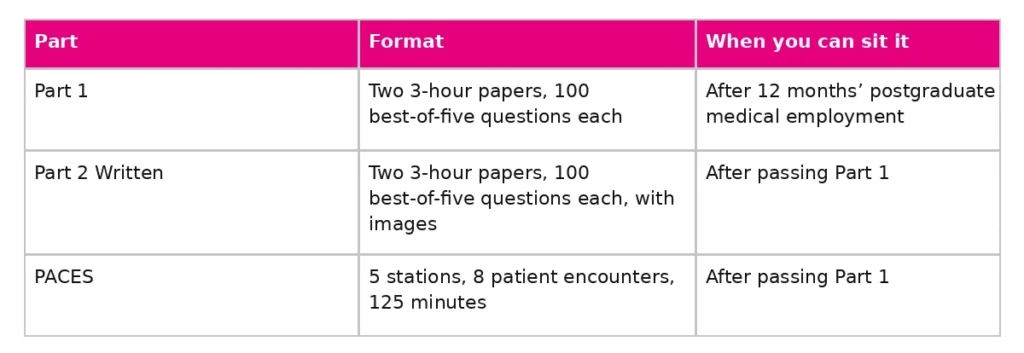
Part 2 Written and PACES can be taken in either order once Part 1 is behind you. The old seven-year limit has gone, so there is no deadline between parts.
Career after MRCP in the UK
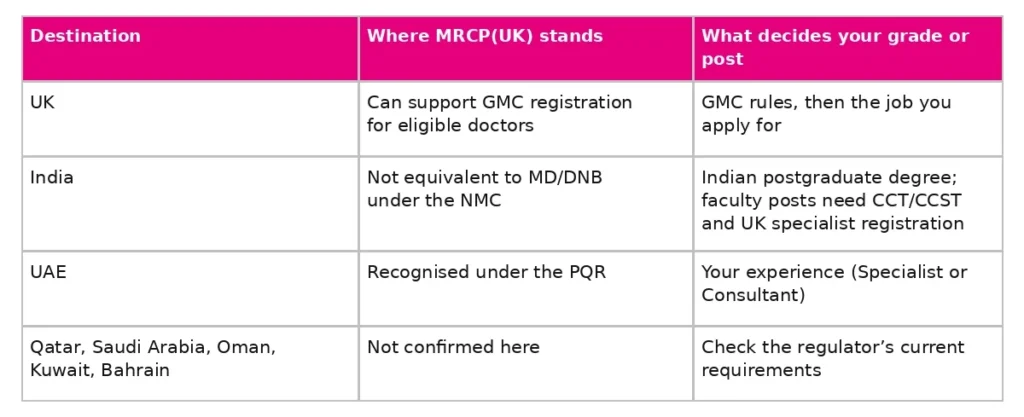
For most international doctors, the UK route starts with registration. Many international doctors use MRCP(UK) instead of PLAB as their route to GMC registration; check the GMC’s current list of acceptable postgraduate qualifications on the General Medical Council website before you plan around it. Read the GMC’s own pages rather than a summary, because the detail is theirs to set and can change.
Once GMC registration is in place, you can apply for NHS jobs in hospital medicine. We won’t quote salaries or promise particular posts: the posts and training routes open to you depend on your experience, the job and the employer.
A few habits make the move smoother. Keep a clean, dated log of your clinical experience and gather references from consultants who have seen your work recently. And start the paperwork early, because registration and job applications both take time. If you are weighing the two registration routes, our comparison of MRCP vs PLAB for a UK career walks through who each suits.
Career after MRCP in India
In India, MRCP(UK) is not treated as equivalent to MD or DNB by the National Medical Commission. The NMC position is that UK royal college memberships do not replace Indian postgraduate degrees, and for medical college faculty posts a UK qualification counts only with CCT or CCST plus UK specialist registration.
So what does a career after MRCP look like if you plan to stay in India? Many doctors treat it as an addition. They complete MD or DNB General Medicine through NEET-PG, and take MRCP alongside or afterwards to keep an international option open. Others work in India for a few years while sitting the parts, then move abroad once all three are done.
Be clear about your aim. If a teaching post in an Indian medical college is the goal, MRCP alone will not get you there. If you want flexibility to work abroad later, it is a sensible investment. Our page on MRCP after MBBS for Indian graduates compares MRCP and MD/DNB side by side.
UAE and the wider Gulf
The UAE’s Unified Professional Qualification Requirements (PQR) recognise exam-based UK royal college membership, so MRCP(UK) counts there. Whether you are licensed at Specialist or Consultant grade depends on your experience, not on the qualification alone. The Ministry of Health and Prevention publishes the current requirements.
For Qatar, Saudi Arabia, Oman, Kuwait and Bahrain, check the regulator’s current requirements before you commit. Each country sets its own rules on which postgraduate qualifications count and how much experience you need, and these get revised.
Choosing a specialty after MRCP
MRCP(UK) is a general physician’s exam, which makes it a starting point for many medical specialties rather than a single track. Cardiology, gastroenterology, respiratory medicine, nephrology, neurology, endocrinology and acute medicine all draw on the knowledge you build for it. Your career after MRCP can lean towards any of these, depending on what you enjoy on the ward.
A simple test helps: which patients do you look forward to seeing, and which on-call problems do you read about without being asked? That curiosity tends to carry you through the longer training that follows. Speak to registrars and consultants in the specialties you are considering, too, because a day in their clinic will tell you more than any list.
Don’t rush the decision before the exams are done. The three parts themselves broaden your medicine, and many doctors change their mind as they go.
Planning the exams around your career goal
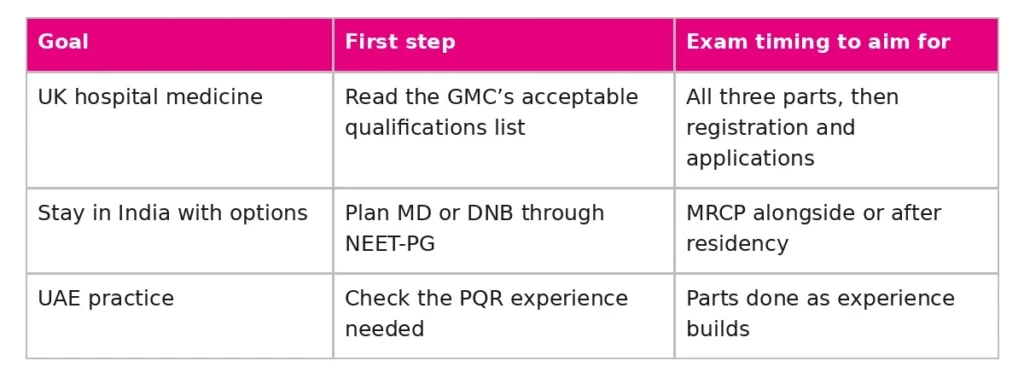
The best plan works backwards from where you want to be. If you aim for the UK, check GMC requirements now and time your parts so that the paperwork and job search can start soon after your final part. If you are in India, think about how MD or DNB and MRCP fit together over the next few years. If the Gulf is the goal, look at how much experience the grade you want requires.
There are practical limits to plan around. You have a maximum of six attempts at each part, and not attending a booked exam counts as one. An exceptional additional attempt can be requested, but don’t build a plan on that. Check upcoming diets on our MRCP exam dates page and the MRCP eligibility rules before you book.
How StudyMEDIC can help with the next step
StudyMEDIC’s clinical programme in internal medicine includes MRCP training, for doctors who want structured experience while they prepare.
If you are at the exam stage, our courses cover each part: MRCP Part 1, MRCP Part 2 and MRCP PACES. Our MRCP courses are led by course director Dr Suman Paul.
Frequently asked questions
Does MRCP(UK) give me GMC registration on its own?
No. Many international doctors use MRCP(UK) instead of PLAB as their route to GMC registration, but you still apply to the GMC and meet its requirements. Check the GMC’s current list of acceptable postgraduate qualifications first.
Is MRCP equal to MD in India?
No. The NMC does not treat UK royal college memberships as equivalent to MD or DNB. For medical college faculty posts, a UK qualification counts only with CCT or CCST plus UK specialist registration.
Can I work in the UAE after MRCP?
MRCP(UK) is recognised under the UAE’s Unified Professional Qualification Requirements. Your grade, Specialist or Consultant, depends on your experience.
What about Saudi Arabia, Qatar or Oman?
Requirements differ by country and change over time, so check the regulator’s current requirements before you plan a career after MRCP in those countries.
Is there a time limit to finish all three parts?
No. The previous seven-year limit has been removed, so there is no time limit between parts. You do have a maximum of six attempts at each part.
Which specialty should I choose after MRCP?
MRCP(UK) supports many medical specialties. Choose by the patients and problems you enjoy most, and talk to doctors already working in the field.
What salary can I expect?
We don’t quote salary figures. Pay depends on the country, the post, your grade and your experience, so check with the employer when you apply.
Talk to our MRCP team about which part to start with and how it fits your career plan.
Related guides:
- What is MRCP: the exam explained
- MRCP vs PLAB: which suits your UK plans
- MRCP after MBBS for Indian graduates
- MRCP eligibility rules