
What is MRCP? It is Membership of the Royal Colleges of Physicians of the United Kingdom, a postgraduate qualification for physicians earned by passing the three-part MRCP(UK) exam: Part 1, Part 2 Written and PACES. Doctors from India, the Gulf and around the world sit it, often in centres close to home.
This guide covers what the exam is, its three parts, fees, eligibility, attempts, centres in India and the Gulf, recognition and how long it usually takes.
Table of Contents
What is MRCP in plain terms
MRCP is the membership exam for physicians run by the Federation of the Royal Colleges of Physicians of the UK. The Federation runs it on behalf of the Royal College of Physicians (London), the Royal College of Physicians of Edinburgh and the Royal College of Physicians and Surgeons of Glasgow.
One quick point before we go further. “MRCP” is also the abbreviation for an MRI scan, MR cholangiopancreatography, so if you searched what is MRCP and landed on radiology pages, that is why. On this site, MRCP always means the MRCP(UK) exam.
In the UK, MRCP(UK) is the membership exam doctors take during internal medicine training. Internationally, it is widely taken, and you manage the whole process, from applying to checking results, through your MyMRCP(UK) account on thefederation.uk.
The three parts of the MRCP(UK) exam
The MRCP UK exam has three parts: two written exams and one clinical exam. Each part is booked and paid for separately.
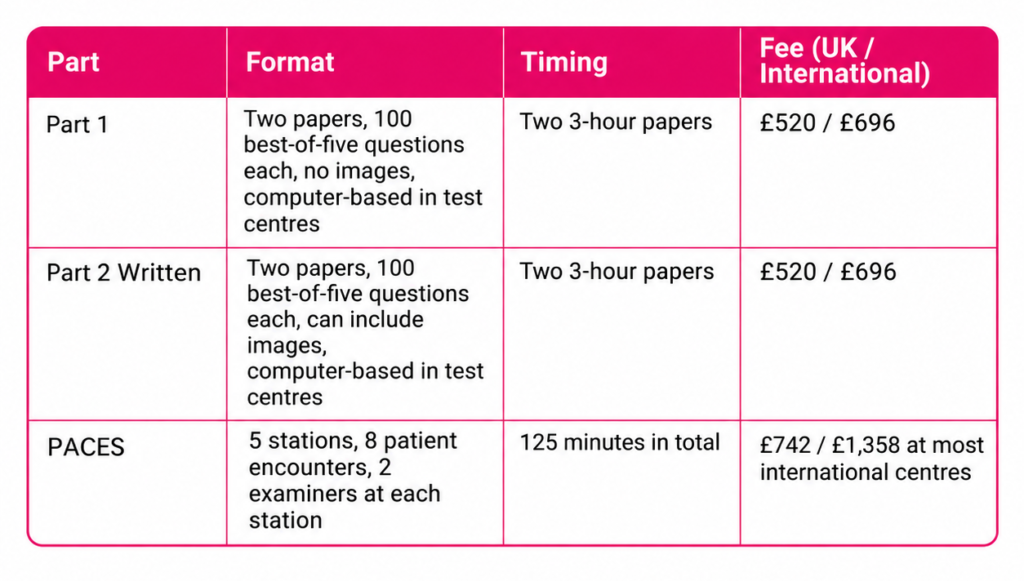
Part 1 tests the medical science and clinical knowledge you need as a physician. Part 2 Written moves further into clinical reasoning, with questions that can include images. Read the Part 1 exam format and Part 2 exam format guides for the detail.
PACES stands for Practical Assessment of Clinical Examination Skills. You rotate through stations covering communication, consultation and the respiratory, cardiovascular, neurological and abdominal examinations, and examiners mark seven skills, A to G. Our PACES exam guide walks through each station.
Order, eligibility and attempts
You must pass Part 1 first; after that, Part 2 Written and PACES can be taken in either order. This flexibility is useful if your ward work makes you feel clinically sharp before you feel ready for another written paper.
To sit Part 1 you need at least 12 months’ postgraduate experience in medical employment. If you are unsure whether your internship or a particular post counts, check how the Federation counts your experience before you apply. For PACES, two years of foundation-level training and 4 months in acute medicine are recommended, but they are not requirements.
There are a maximum of six attempts at each part, and an exceptional additional attempt can be requested. Not attending a booked exam counts as an attempt. The old rule that you had to pass every part within seven years of Part 1 has been removed, so there is no time limit between parts. Our MRCP eligibility guide covers these rules in full.
Exam dates and centres in India and the Gulf
Part 1 and Part 2 Written run three times a year, and PACES international diets run over longer assessment periods. For example, the next Part 1 is on 20 January 2027 and Part 2 Written sits on 25 November 2026. The full list is on our MRCP exam dates page.
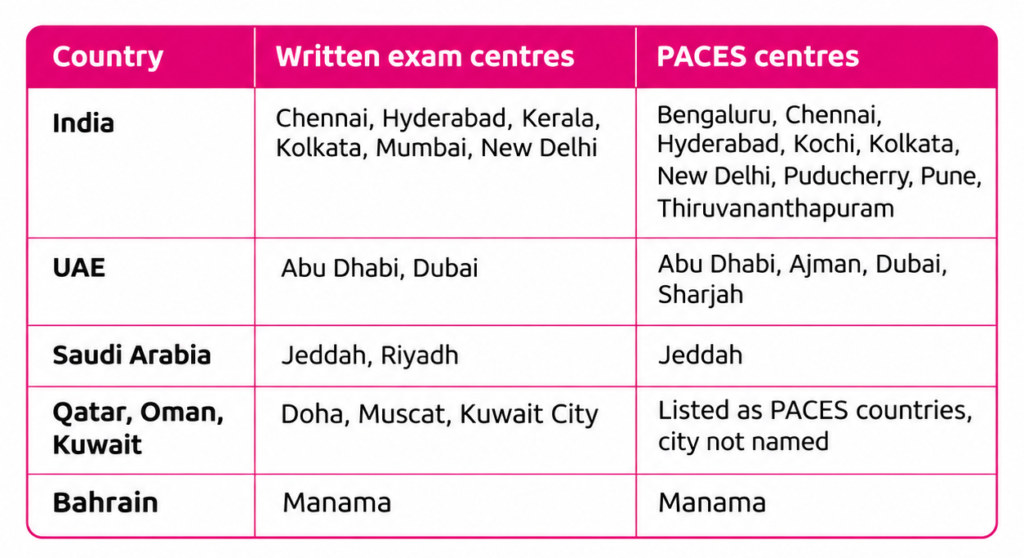
International PACES has had more candidates than places, and the Federation has acknowledged a waiting list. You can choose up to four centres, so list several you can travel to. Centres can change by diet, so check the Federation’s list when you apply.
Recognition in the UK, India and the Gulf
The honest answer to “what is MRCP worth?” depends on where you want to work, and each regulator sets its own rules. Here is what we can say with confidence.
UK:
PLAB is the GMC’s test for international doctors seeking UK registration. Many international doctors use MRCP(UK) instead of PLAB as their route to GMC registration; check the GMC’s current list of acceptable postgraduate qualifications. Our comparison of MRCP vs PLAB helps you decide which route suits you.
India:
Under the NMC, UK royal college memberships are not equivalent to MD or DNB. For medical-college faculty posts, UK qualifications count only with CCT or CCST plus UK specialist registration.
UAE:
The Unified Professional Qualification Requirements (PQR) recognise exam-based UK royal college membership, and whether you are graded as a Specialist or Consultant depends on your experience. See the Ministry of Health and Prevention for current rules.
Qatar, Saudi Arabia, Oman, Kuwait and Bahrain:
Check each regulator’s current requirements before you plan around the qualification.
How long does MRCP(UK) take?
There is no fixed answer, because the timeline depends on the diets you choose, the PACES waiting list and how much study time your job allows. With three written diets a year and no time limit between parts, you can move at a pace that suits you.
A typical approach is to sit Part 1 once you meet the 12-month rule, then choose Part 2 Written or PACES next, leaving enough weeks to prepare properly for each. You need a Part 1 pass before Part 2 Written or PACES, so leave room for results in your plan. Doctors who plan the whole MRCP UK route at the start, rather than one part at a time, usually waste fewer diets.
How to start your MRCP journey
Start with Part 1: confirm your eligibility, pick a diet, and build a study plan around it. Then think early about where you want to use the qualification, because that shapes the order you take the later parts.
If you want structured clinical experience alongside the exam, look at StudyMEDIC’s clinical programme in internal medicine, which includes MRCP training. For exam preparation, our MRCP Part 1 course is led by course director Dr Suman Paul. Once you understand what is MRCP and where it fits in your plans, read about career after MRCP to see the routes it can open.
Frequently asked questions
What is MRCP in medicine?
In medical careers, MRCP means Membership of the Royal Colleges of Physicians of the United Kingdom, gained by passing the MRCP(UK) exam. The same letters also describe an MRI scan of the bile ducts, MR cholangiopancreatography.
Who conducts the MRCP(UK) exam?
The Federation of the Royal Colleges of Physicians of the UK runs it on behalf of the three colleges in London, Edinburgh and Glasgow. You apply through your MyMRCP(UK) account on thefederation.uk.
How many parts does the exam have?
Three: Part 1, Part 2 Written and PACES. You must pass Part 1 first, then take the other two in either order.
Can I sit MRCP in India?
Yes. Written centres include Chennai, Hyderabad, Kerala, Kolkata, Mumbai and New Delhi, and PACES runs at several Indian centres including Bengaluru, Kochi and Pune.
Is MRCP(UK) equal to MD in India?
No. Under the NMC, UK royal college memberships are not equivalent to MD or DNB. For faculty posts, UK qualifications count only with CCT or CCST plus UK specialist registration.
Is there a time limit to complete MRCP?
No. The previous seven-year limit has been removed. Each part allows a maximum of six attempts, and a missed booked exam counts as one.
How much does the MRCP UK exam cost?
Part 1 and Part 2 Written each cost £520 (UK) or £696 (international). PACES costs £742 in the UK and £1,358 at most international centres.
Have questions about where to begin? Talk to our MRCP team.
Related guides:
- MRCP exam dates for 2026 and 2027
- MRCP eligibility explained
- MRCP Part 1 exam format
- MRCP vs PLAB for a UK career