

MRCP vs PLAB comes down to what you want from the UK: PLAB is the GMC’s test for international doctors seeking registration, while MRCP(UK) is a postgraduate physician qualification that many international doctors also use as their route to registration. If you are early in your career and want to start working in the UK soon, PLAB is the usual path. If you are committed to medicine as a specialty and want a qualification that is also recognised in the UAE under the PQR, MRCP(UK) often makes more sense.
This guide covers what each exam is, a side-by-side comparison, a decision guide by career stage, whether you can do both, and the angle for doctors in India and the Gulf.
Table of Contents
What PLAB is
PLAB is the General Medical Council’s test for international doctors who want GMC registration. It is about registration rather than a specialty; check the GMC for its format and who can take it.
The GMC sets the format, eligibility, fees and test locations for PLAB, and these can change. So read the details directly on the GMC website rather than relying on summaries, including this one.
What MRCP UK is
MRCP UK, written formally as MRCP(UK), is the Membership of the Royal Colleges of Physicians of the United Kingdom. The Federation of the Royal Colleges of Physicians of the UK runs it on behalf of the Royal College of Physicians (London), the Royal College of Physicians of Edinburgh and the Royal College of Physicians and Surgeons of Glasgow. In the UK it is the membership exam physicians take during internal medicine training.
It has three parts, and Part 1 comes first: two 3-hour papers of 100 best-of-five questions each.
Part 2 Written follows the same structure with images, and PACES is a clinical exam with 5 stations and 8 patient encounters over 125 minutes. You can sit Part 1 after 12 months’ postgraduate experience in medical employment, and you book through your MyMRCP(UK) account on the Federation’s website. Our guide to what MRCP is covers each part in more depth.
On GMC registration, the position is this: many international doctors use MRCP(UK) instead of PLAB as their route to GMC registration; check the GMC’s current list of acceptable postgraduate qualifications before you rely on it.
MRCP vs PLAB side by side
The clearest way to compare the two is by purpose. PLAB is built for registration. MRCP(UK) is built to test physicians, and registration is one of the things it can support for eligible doctors.
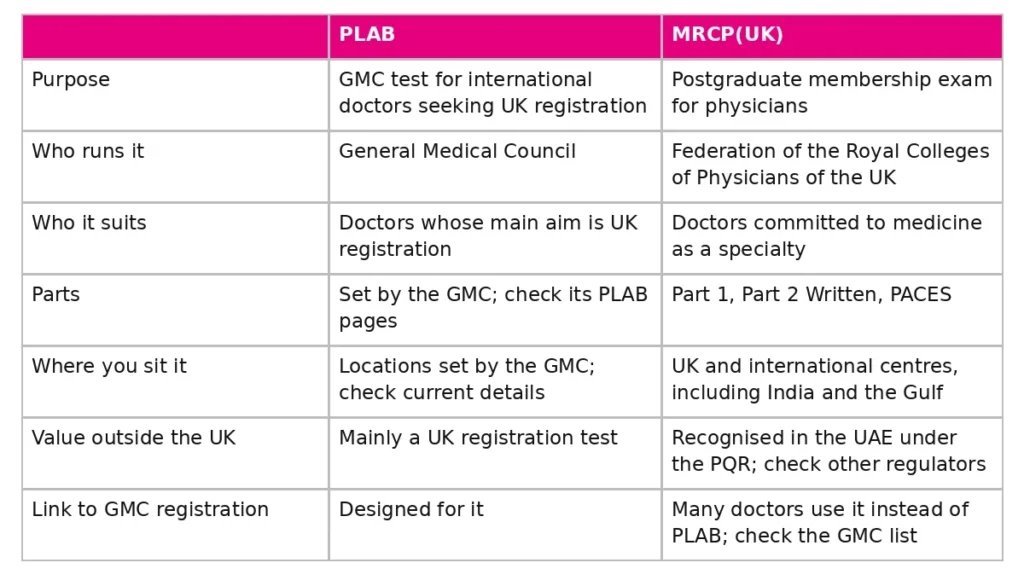
Neither is “better” in general. They solve different problems, and the right one depends on your stage and goal.
Which one suits your career stage?
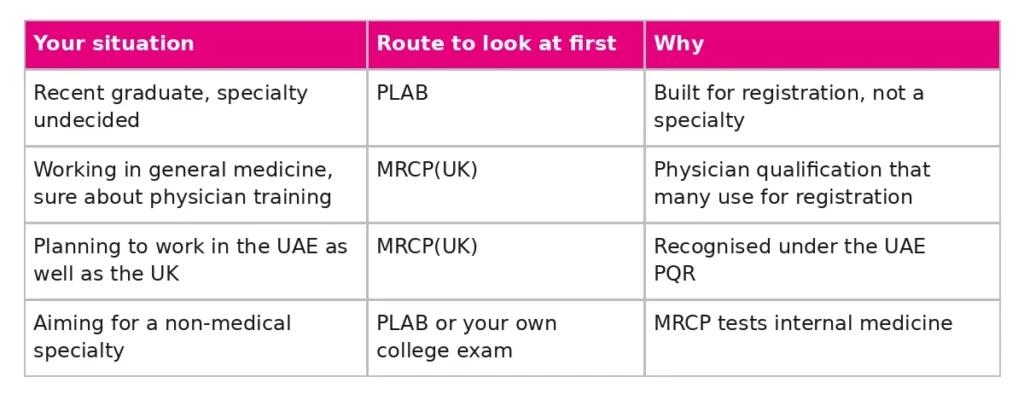
Your stage of career settles most MRCP vs PLAB decisions. Start by asking where you want to be in five years, and in which specialty.
If you are a recent graduate with no fixed specialty yet, PLAB usually fits better. It is aimed at registration, not at one specialty. You can still take MRCP later.
If you have already spent time in general medicine and know you want to be a physician, MRCP(UK) is worth a hard look. The preparation deepens your medicine, and the qualification travels with you. There are three parts to plan, and international PACES has had more candidates than places, so you may need to list several centres.
If you are aiming for a specialty outside medicine, such as surgery or obstetrics, MRCP(UK) is the wrong exam. Look at PLAB or the postgraduate exam for your own field instead. The table below sums up the MRCP vs PLAB choice by situation.
Can you do both MRCP and PLAB?
Yes, MRCP vs PLAB doesn’t have to be either-or: nothing stops you sitting both, and some doctors do. A common reason is timing. A doctor may take PLAB to get GMC registration and start working in the UK, then sit MRCP(UK) parts while in an NHS post.
The other order works too. You might pass MRCP Part 1 at home, then decide PLAB suits your timeline better while you prepare for the remaining parts. Because the seven-year limit between MRCP parts has been removed, a gap does not cost you your Part 1 pass. You do have a maximum of six attempts at each part, so plan each sitting seriously.
What you should avoid is preparing for both at once with no clear priority. Pick the exam that matches your next step, finish it, then decide.
MRCP vs PLAB for doctors in India and the Gulf
For doctors in India, the choice often comes with a third option: MD or DNB at home. Under the National Medical Commission, UK royal college memberships are not equivalent to MD or DNB, and for medical college faculty posts UK qualifications count only with CCT or CCST plus UK specialist registration. If an Indian teaching post is your goal, neither PLAB nor MRCP replaces an Indian postgraduate degree. Our page on MRCP after MBBS compares them in detail.
For the Gulf, MRCP(UK) has a practical edge in the UAE. The Unified Professional Qualification Requirements recognise exam-based UK royal college membership, with your Specialist or Consultant grade depending on experience. For Qatar, Saudi Arabia, Oman, Kuwait and Bahrain, check the regulator’s current requirements.
Location helps too. Part 1 and Part 2 Written run at computer-based centres in India and the Gulf, and PACES has centres across both regions. See our MRCP exam dates guide for upcoming diets and MRCP eligibility for the entry rules.
Making your decision
Make the MRCP vs PLAB call by writing down three things: the country you want to work in, the specialty you want, and how soon you need to start. If the answers are “UK, undecided, soon”, PLAB fits. If they are “UK or Gulf, medicine, willing to invest a little longer”, MRCP(UK) fits.
Whichever you choose, confirm the current GMC registration rules on the GMC website first. Then plan backwards from your target start date. If MRCP is your route, our MRCP Part 1 course is the place to begin, and our guide to career after MRCP shows where it can lead.
Frequently asked questions
Can MRCP replace PLAB for GMC registration?
Many international doctors use MRCP(UK) instead of PLAB as their route to GMC registration. Check the GMC’s current list of acceptable postgraduate qualifications before you rely on it.
Is MRCP harder than PLAB?
They test different things, so MRCP vs PLAB isn’t really a contest of difficulty. MRCP(UK) has three parts aimed at physicians, while PLAB is the GMC’s registration test.
Should a fresh graduate choose MRCP or PLAB?
If your specialty is undecided and you want to work in the UK soon, PLAB usually fits better. You need 12 months’ postgraduate medical employment before you can sit MRCP Part 1 anyway.
Can I take PLAB and MRCP together?
You can sit both, and some doctors do. It usually works better to finish one with a clear purpose before starting the other.
Does PLAB help me work in the Gulf?
PLAB is mainly a route to GMC registration in the UK. In the UAE, the PQR recognises exam-based UK royal college membership such as MRCP(UK); for other Gulf countries, check the regulator’s current requirements.
Do I need Part 2 before PACES?
No. Once you pass Part 1, you can take Part 2 Written and PACES in either order.
Talk to our MRCP team if you are still deciding between the two routes.
Related guides:
- What is MRCP: the exam explained
- Career after MRCP in the UK, India and the Gulf
- MRCP after MBBS for Indian graduates
- MRCP eligibility rules