
MRCP PACES preparation works best as a 12-week plan built around the five stations: polished examination routines for the four systems, regular communication and consultation practice with a partner, and timing drills until 10 and 20 minutes feel natural. Reading helps, but PACES is passed with your hands, your eyes and your words, so most of your time should go on practice with real or simulated patients.
This guide to the clinical part of the MRCP(UK) exam covers when to start, a station-by-station plan, examination routines, partner practice, timing drills, mock exams, travel to the centre and the final week.
Table of Contents
When to start MRCP PACES preparation
Start around 12 weeks before your assessment window, and earlier if you are not seeing many patients at the moment. You can sit PACES once you have passed Part 1, in either order with Part 2 Written.
The regulations recommend, but do not require, two years of foundation-level training and 4 months in acute medicine before PACES. If you have less clinical exposure than that, give yourself extra time on the wards before you start the formal plan.
Know your dates before you map out your MRCP PACES preparation. International PACES runs through set application windows and assessment periods, which you can find on the Federation’s PACES dates and fees page and our MRCP exam dates guide. If you need a reminder of how the circuit works, read our guide to the MRCP PACES exam first.
A 12-week MRCP PACES preparation plan by station
This plan rotates through the stations so that nothing is left to the last fortnight. The circuit has five stations: Station 1 (communication and respiratory), Station 2 (consultation), Station 3 (cardiovascular and neurological), Station 4 (communication and abdominal) and Station 5 (consultation).
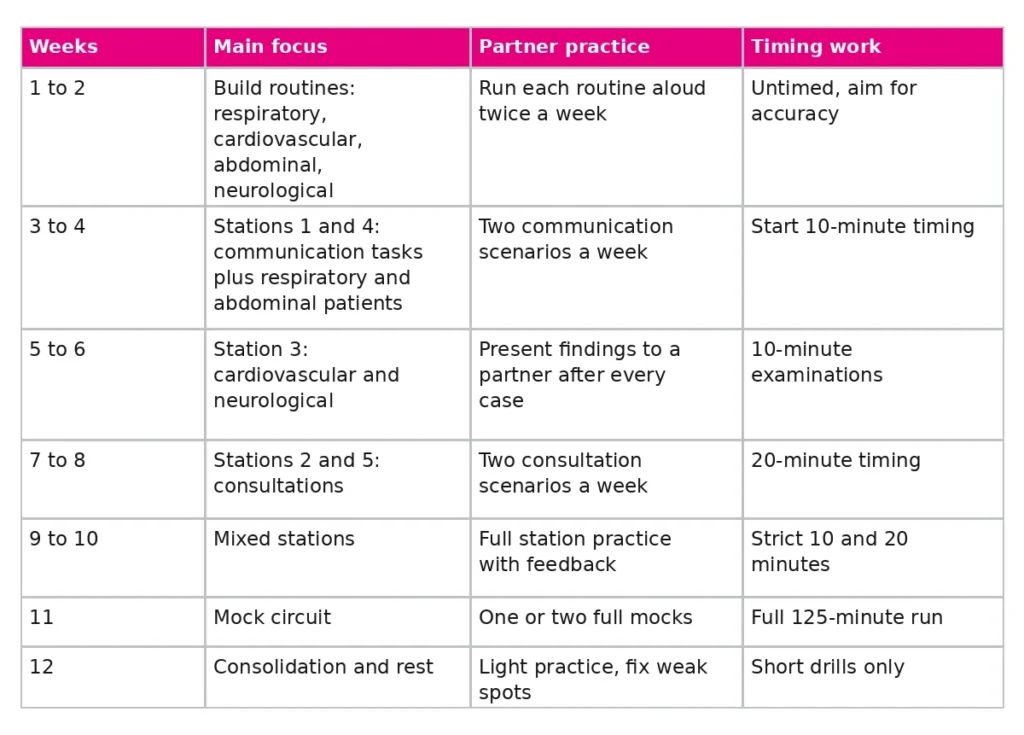
This plan rotates through the stations so that nothing is left to the last fortnight. The circuit has five stations: Station 1 (communication and respiratory), Station 2 (consultation), Station 3 (cardiovascular and neurological), Station 4 (communication and abdominal) and Station 5 (consultation).Keep a short log after each PACES practice session. Write down what went well, what you missed and one thing to change next time. Over 12 weeks, that log becomes the most useful part of your MRCP PACES preparation.
Examination routines for the four systems
A smooth, well-rehearsed routine is the foundation of MRCP PACES preparation, because it frees your mind to think about the findings. In the exam you have 10 minutes for each examination encounter, and you cannot afford to wonder what comes next.
Build one routine each for the respiratory, cardiovascular, neurological and abdominal systems, and practise them until they are automatic. Run them on friends, on colleagues and, above all, on patients on the ward, where PACES practice feels closest to the real thing. Each time, finish by presenting your findings aloud in a clear order, then give a likely diagnosis and a sensible next step.
Neurology deserves extra attention because the range of cases is wide and the examination is long. Practise both upper and lower limb examinations, cranial nerves and the core patterns until you can move from one to another without losing time. For every system, ask a senior to watch you at least once and tell you honestly what looks clumsy.
Communication and consultation practice with a partner
Communication and consultation skills only improve with a partner, so find one early and meet regularly. PACES practice in pairs or small groups lets one person play the patient or relative, one the candidate, and one the examiner.
For the 10-minute communication tasks in Stations 1 and 4, rehearse common conversations: explaining a diagnosis, discussing a treatment decision, breaking difficult news, or handling an upset relative. The aim is not a script. It is the habit of listening first, checking understanding and agreeing a clear plan together.
The 20-minute consultations in Stations 2 and 5 typically combine history, focused examination, explanation and planning. Use real cases from your ward work as scenarios, and swap roles so you also see what good and poor consultations look like from the patient’s side. That perspective is one of the most valuable parts of any MRCP PACES preparation.
Timing drills for 10 and 20 minutes
Timing is where many well-prepared doctors stumble, so make it a separate strand of your MRCP PACES preparation. Use a timer for every practice case from week 3 onwards.
For 10-minute examinations, aim to finish the examination with time left to present and answer questions. For 20-minute consultations, practise dividing the time into history, examination where needed, explanation and plan, and practise wrapping up politely when the time is nearly gone. You will also have 5 minutes between stations; in practice sessions, use a short gap to reset before the next case.
Good PACES practice includes deliberately running out of time once or twice, so you learn how to close an encounter safely rather than stopping mid-sentence.
Mock exams and feedback
A full mock circuit is the best PACES practice you can get, because it shows you how tiring 125 minutes of continuous assessment really is. Book at least one full mock in week 11, and treat it like the real day: same start time, same clothes, no notes.
The value of a mock lies in the feedback. Ask examiners to mark you against the seven skills, A to G, that the Federation lists on its PACES page, and note where your marks are consistently weaker. The Federation’s PACES format page sets out the station layout so your mock can match it.
If you would like structured teaching, supervised practice and mock circuits, the MRCP PACES course led by our course director, Dr Suman Paul, is built around this kind of feedback.
Travel, the centre and the final week
Plan the practical side of your MRCP PACES preparation as carefully as the clinical side. International PACES has had more candidates than places, and you can choose up to four centres, so list several you can realistically reach. Indian centres include Bengaluru, Chennai, Hyderabad, Kochi, Kolkata, New Delhi, Puducherry, Pune and Thiruvananthapuram; in the UAE there are Abu Dhabi, Ajman, Dubai and Sharjah. Check the PACES centre locations when you apply, as they can change by diet.
Once you know your centre, sort out leave, travel and accommodation early. If you are flying in, arrive the day before so you are not rushing on the morning of the exam.
In the final week, keep PACES practice light and focused on routines and short timing drills. Do not try to learn new topics. Sleep well, eat properly, and go in with a calm, practised approach. Results for international candidates arrive 20 to 30 working days after the last day at your centre, and our MRCP results guide explains what to do next.
Frequently asked questions
How long should MRCP PACES preparation take?
Many doctors plan around 12 weeks of structured PACES practice. Allow longer if you are not seeing many patients at the moment.
Can I prepare for PACES alone?
You can practise examination routines alone, but communication and consultation stations need a partner. Regular PACES practice in a small group works well.
How do I get better at timing?
Use a timer for every case from early on. Practise 10-minute examinations and 20-minute consultations until finishing on time feels natural.
Should I do a mock exam?
Yes. A full mock circuit in the last few weeks of MRCP PACES preparation shows you how tiring the 125 minutes can be and gives you useful feedback.
Do I need to pass Part 2 Written before PACES?
No. After Part 1, you can take Part 2 Written and PACES in either order.
Which centres should I choose?
You can choose up to four centres. List several you can travel to, since international demand has exceeded places in the past.
Talk to our MRCP team about your plan, or explore the MRCP PACES course.