

Good MRCP Part 1 preparation for a working doctor usually takes 12 to 16 weeks of steady study, built around daily question practice rather than long reading sessions. Start once you know your exam date, give the first half of your plan to covering every specialty, and spend the second half on timed papers and review. The final four weeks are about stamina and fixing weak areas, not learning new topics.
This guide covers when to start, a 16-week and a 12-week study plan, studying around shifts, a method for question practice and review, timing for two 3-hour papers, the final four weeks and the mistakes we see most often.
Table of Contents
When to start your MRCP Part 1 preparation
Start about 16 weeks before the exam if you work full time, or 12 weeks if you have protected study time or strong recent knowledge. Those figures are a starting point, not a rule. A doctor fresh from final exams may need less; one who has spent two years in a narrow specialty may need more.
Work back from a real date. The next Part 1 diets are 20 January 2027, 26 May 2027 and 29 September 2027, and applications for the January diet closed on 3 November 2026. Our MRCP exam dates guide lists the application windows as they are announced.
Before you plan, check you can sit the exam: Part 1 needs at least 12 months’ postgraduate experience in medical employment. Our MRCP eligibility guide explains the rule and how the parts fit together.
A 16-week study plan
The 16-week study plan suits most doctors who are working full time. It splits into three phases: broad learning, consolidation, and timed practice. Each week assumes roughly 12 to 15 hours of study, spread across workdays and days off.
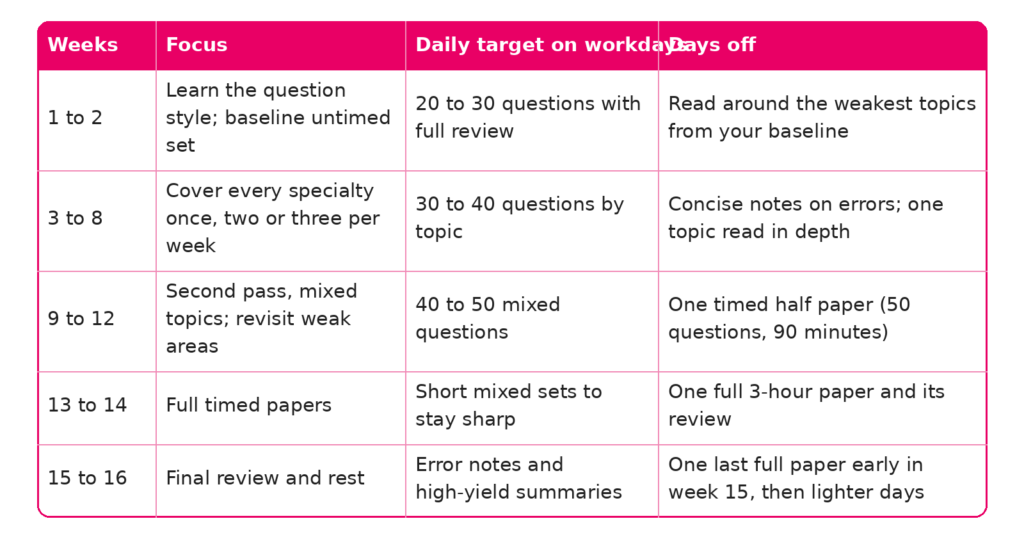
The plan works because every topic comes up at least twice. Your first pass shows you what you do not know, and the second pass is where it sticks. If a specialty is a real weakness, add a third pass in weeks 13 and 14 rather than letting it slide.
A 12-week study plan
A 12-week study plan compresses the same phases and suits doctors with protected time or recent exam experience. It asks for more hours, usually 15 to 20 a week, and leaves less room for a bad week on the rota.
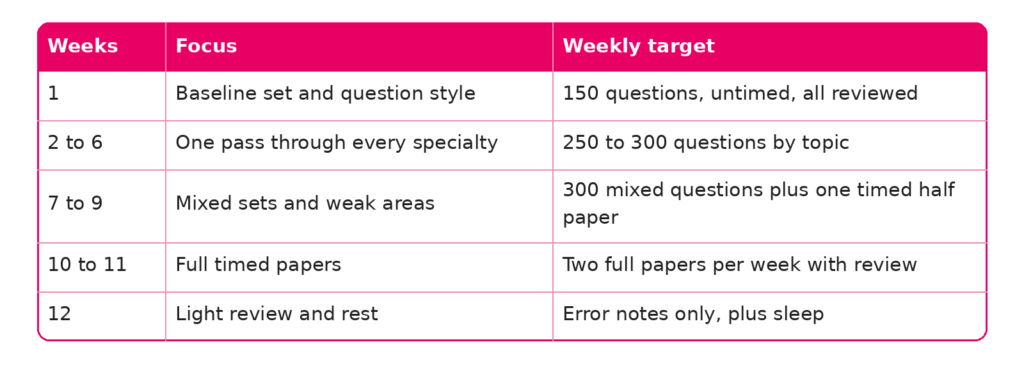
If you choose the 12-week route, protect your days off ruthlessly. Most of the full papers have to land on them, and a missed weekend is hard to make up when the whole plan is shorter.
Studying while working shifts
MRCP Part 1 preparation alongside a full rota is mostly about using small blocks of time well. Thirty focused minutes of question practice before a shift is worth more than two distracted hours after a night. Plan around your rota a month at a time, and mark which days are realistic for study and which are not.
On long days and nights, aim small: ten or twenty questions on your phone during a break, and nothing more. On post-nights, rest first. Your real study happens on days off and normal working days, so that is where the full papers and deeper reading go.
Tell your family and colleagues roughly when your exam is. It sounds simple, but having people who understand why you are skipping a weekend makes the last month far easier.
Question practice and how to review it
Question practice is the core of MRCP Part 1 preparation, but the review is where the learning happens. For every question, right or wrong, ask why the best answer beats the second best. If you guessed correctly, treat it as wrong and read the explanation properly.
Keep a short error log. Write one line per mistake: the topic, what you chose, what the answer was and the reason. Over a few weeks this log becomes your most useful revision document, because it is built from your own gaps rather than someone else’s summary.
Mix untimed and timed work. Untimed sets early on teach you to read stems properly, and timed sets later build speed. If you only ever do one kind, you will either be slow or careless on the day. Our guide to the MRCP Part 1 exam format explains how best-of-five questions are built, which helps you read them faster.
Timing for two 3-hour papers
Each Part 1 paper gives you 3 hours for 100 questions, which is just under two minutes per question. In practice, aim to finish a first pass in about two and a quarter hours, then use the remaining time for flagged items. Never leave a question blank; there is always a best guess.
Stamina matters as much as speed, because you sit two 3-hour papers in the same diet. That is why the plans above include full 3-hour papers in the last month. Sit at least two under real conditions, at a desk, with no phone, and if you can, sit two back to back.
The final four weeks
Your final four weeks should be about consolidation, timing and rest, not new material. By now your error log tells you where the marks are being lost. Go back to those topics, do focused questions on them and re-read your notes.
Keep a light daily rhythm in the last week. A short mixed set each morning, a glance at your error log, and an early night. Check your centre, travel and identification documents in your MyMRCP(UK) account on thefederation.uk a few days before. Nothing about the last 48 hours should be a surprise.
Common mistakes in MRCP Part 1 preparation
The most common mistake is reading too much and practising too little. Textbooks feel productive, but the exam rewards fast judgement on best-of-five items, and only question practice builds that. A second mistake is avoiding weak specialties because they are uncomfortable, which leaves easy marks on the table.
Other errors we see often: doing questions without reviewing them, never sitting a full timed paper before the exam, and changing resources every few weeks. Pick one solid question bank and one concise reference, and stick with them. Finally, do not book an exam you are clearly not ready for, because not attending a booked exam still counts as an attempt.
If you want structure, the MRCP Part 1 course led by Dr Suman Paul combines teaching with guided question practice. For a wider view of the exam, read what MRCP is and how Part 1 leads on to Part 2 Written and PACES.
Frequently asked questions
How long does MRCP Part 1 preparation take?
Most working doctors need 12 to 16 weeks. Sixteen weeks suits a full-time rota; twelve weeks suits doctors with protected study time or recent exam experience.
How many questions should I do each day?
Around 30 to 50 on workdays during the main phase of a 16-week study plan, with full review of each one. On long shifts, a small set of ten to twenty is enough.
Should I read textbooks or do questions?
Mostly questions. Use a concise reference to fill gaps your question practice reveals, rather than reading cover to cover.
How do I manage time in a 3-hour paper?
You have just under two minutes per question. Aim to finish a first pass with time to spare, flag hard items and return to them, and never leave a question blank.
What should I do in the last week?
Light review only: short mixed sets, your error log and plenty of sleep. Check your centre and documents in your MyMRCP(UK) account a few days before.
Can I prepare while working full time?
Yes, many do. Plan your study around your rota, use short blocks on busy days, and keep your full timed papers for days off.
Talk to our MRCP team or explore the MRCP Part 1 course to plan your preparation.
Related guides:
- MRCP Part 1 exam format
- MRCP exam dates for Part 1, Part 2 and PACES
- MRCP results: what to do next
- MRCP eligibility explained