
The MRCP Part 1 exam format is two 3-hour papers, each with 100 best-of-five multiple-choice questions, taken on computer at a test centre. There are no images in Part 1, so every question is text only. It is the first of the three parts of the MRCP(UK) exam and must be passed before you can sit Part 2 Written or PACES.
This guide covers the structure of the papers, how best-of-five questions work (with a sample question), what the exam tests, computer-based delivery, centres in India and the Gulf, fees and upcoming dates.
Table of Contents
MRCP Part 1 exam format at a glance
Part 1 consists of two papers in the same diet, each lasting three hours and containing 100 questions. That gives you 200 questions and six hours of testing in total. Every question is a best-of-five item: a clinical or scientific scenario followed by five options, of which you choose the single best answer.
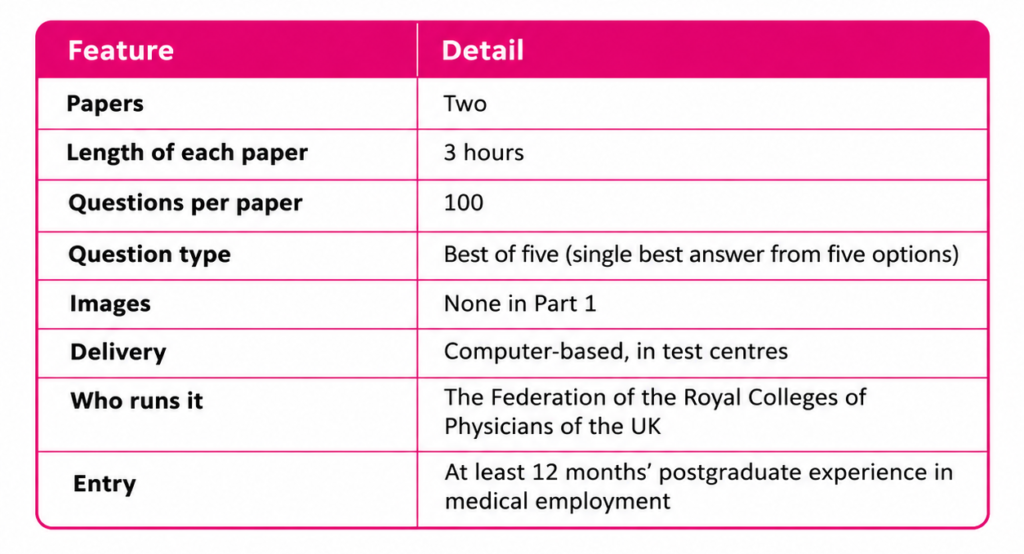
The Federation’s Part 1 exam page is the official reference for the format and is worth bookmarking. If you are still checking whether you can apply, our MRCP eligibility guide explains the 12-month rule and the order of the parts.
How best-of-five questions work
A best-of-five question asks you to pick the most appropriate answer from five options, where more than one option may be partly right. That is the key difference from a simple true-or-false format. You are not hunting for the only correct statement; you are judging which choice a good physician would make first.
Each question has three parts. The stem gives you the scenario, usually a patient with history, examination findings and some results. The lead-in asks a specific question, such as the most likely diagnosis or the most appropriate next step. Then come five options, listed in a consistent style.
Because Part 1 has no images, any investigation results appear as text or numbers within the stem. You will read blood results, ECG descriptions and other findings rather than see them. Learning to scan a dense stem quickly and pick out what matters is a skill in itself, and it improves with steady practice on best of five questions.
A sample best-of-five question
Here is an original sample question written for this guide. It is not taken from the exam and only shows the style of item you will meet.
A 68-year-old man with chronic kidney disease is brought to the emergency department with generalised weakness. His serum potassium is 7.1 mmol/L. An ECG shows tall, peaked T waves and broadening of the QRS complexes. What is the most appropriate immediate treatment?
| Option | Answer |
| A | Oral calcium resonium |
| B | Intravenous calcium gluconate |
| C | Intravenous furosemide |
| D | Nebulised salbutamol alone |
| E | Repeat potassium in one hour |
The best answer is B. With ECG changes, the first priority is to stabilise the cardiac membrane, which is what intravenous calcium does. Insulin with glucose and other measures to shift or remove potassium follow, but they do not protect the heart in the first minutes. Several options here are reasonable parts of hyperkalaemia care, which is exactly why the item tests judgement rather than recall alone.
Notice how the lead-in, “most appropriate immediate treatment”, does the real work. If it had asked for the best long-term step, the answer would change. Reading the lead-in carefully before the options is a habit that pays off across both papers.
What the papers test
The content behind the MRCP Part 1 exam format spans the clinical sciences and the major medical specialties, with questions that test both your knowledge and how you apply it to patients. You can expect material from across general internal medicine, along with the basic science that underpins clinical decisions.
We do not reproduce topic weightages here because they can change, and an out-of-date figure is worse than none. Check the Federation’s Part 1 page for current guidance on content when you plan your revision.
A practical point for the MRCP Part 1 exam format is that breadth matters as much as depth. A topic you think of as small can still bring several questions, and gaps across many specialties hurt more than a weak spot in one. Plan your study so that you touch every area more than once.
Computer-based delivery and the exam day
Under the current MRCP Part 1 exam format, the papers are delivered on computer in test centres, following the move of the written exams to in-centre computer-based testing from January 2026. You sit at a workstation, read each question on screen and select your answer. Both 3-hour papers belong to the same diet.
With 100 questions in 3 hours, you have just under two minutes per question on average. Some best of five questions take thirty seconds, others need careful reading of a long stem. Most candidates do best with a steady first pass, flagging the hard items and returning to them once every question has an answer.
On the day, plan your journey so you reach the centre in good time, and take the identification the Federation asks for. Your booking details, centre address and instructions all sit in your MyMRCP(UK) account on thefederation.uk, so check them a few days before.
Centres, fees and dates
Part 1 is offered at centres in the UK and internationally, including India and the Gulf. In India the written centres are Chennai, Hyderabad, Kerala, Kolkata, Mumbai and New Delhi. In the Gulf they are Abu Dhabi, Dubai, Doha, Jeddah, Riyadh, Muscat, Kuwait City and Manama.
The fee is £520 for UK candidates and £696 for international candidates. If you pay in rupees or dirhams, the cost will be roughly whatever the exchange rate is on the day you pay.
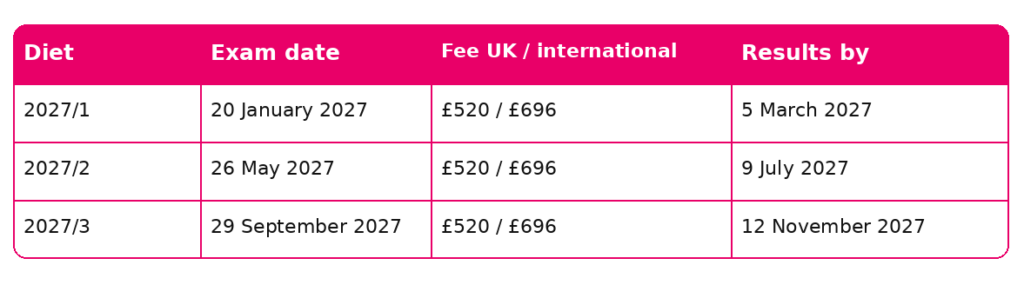
Applications for the January 2027 diet closed on 3 November 2026. For other application windows, see our MRCP exam dates guide or the Federation’s Part 1 dates and fees page. When results are out, our guide to MRCP results explains what to do next.
Preparing for this format
Knowing the MRCP Part 1 exam format shapes how you should study. Two long papers reward stamina, and best-of-five items reward judgement, so your revision needs both reading and plenty of timed question practice. Reading textbooks alone rarely builds the speed you need on the day.
Start by working through questions untimed to learn the style, then move to timed blocks that mirror a full paper. Review every answer, right or wrong, and note why the best option beat the second best. Our MRCP Part 1 preparation guide has 16-week and 12-week plans built around this method.
If you want structured teaching and question practice, the MRCP Part 1 course is led by course director Dr Suman Paul. You can also see short teaching videos on the StudyMEDIC YouTube channel.
Frequently asked questions
How many questions are in the MRCP Part 1 exam format?
There are 200 questions in total: two papers with 100 best-of-five questions each. Each paper lasts three hours.
Are there images in MRCP Part 1?
No. Part 1 has no images, so results and findings appear as text within the question. Images appear in Part 2 Written.
Is Part 1 taken on paper or on computer?
On computer, at a test centre. The written exams moved to in-centre computer-based testing from January 2026.
Can I sit Part 1 in India or the Gulf?
Yes. Written centres include Chennai, Hyderabad, Kerala, Kolkata, Mumbai and New Delhi in India, and Abu Dhabi, Dubai, Doha, Jeddah, Riyadh, Muscat, Kuwait City and Manama in the Gulf.
How much time do I get per question?
Each paper gives you 3 hours for 100 questions, which works out at just under two minutes per question on average.
Where can I see what topics Part 1 covers?
Check the Federation’s Part 1 page for current guidance on content. Use that rather than older weightage lists, which may be out of date.
Talk to our MRCP team about the Part 1 course and how to plan your first attempt.
Related guides:
- MRCP Part 1 preparation: study plans and method
- MRCP eligibility for Part 1, Part 2 and PACES
- MRCP Part 2 exam format
- What is MRCP? The MRCP(UK) exam explained