

Good MRCP Part 2 preparation is built around the exam itself: two 3-hour papers of best-of-five questions that can include images, testing how you reason through a patient rather than what you can recall. For most working doctors, a focused 12-week plan of daily timed questions, regular image practice and honest review is a sensible target once Part 1 is behind you.
This guide covers when to start, a week-by-week plan, image and data practice, a reasoning method for best-of-five questions, using ward work, whether to take PACES first, and the final weeks.
Table of Contents
When to start MRCP Part 2 preparation
Start as soon as you have passed Part 1 and chosen a diet, ideally giving yourself around three months of steady work. You need a Part 1 pass before you can sit Part 2 Written, but nothing stops you reading ahead while you wait for Part 1 results.
Pick the diet first and work backwards from it. The Federation runs three Part 2 Written diets a year, and application windows can be as short as a week, so book the window into your calendar. The next exam dates are on our MRCP exam dates page and on the Federation’s Part 2 dates and fees page.
If you are not sure how the papers are built, read our guide to the MRCP Part 2 exam format before you plan anything else. Everything below follows from that structure.
A 12-week MRCP Part 2 preparation plan
This plan assumes you are fitting Part 2 Written revision around a full-time job and can find about two hours on most weekdays and longer sessions at weekends. Treat it as a frame, not a contract. If a week of nights wipes out your study time, slide the plan along rather than trying to catch up in one weekend.
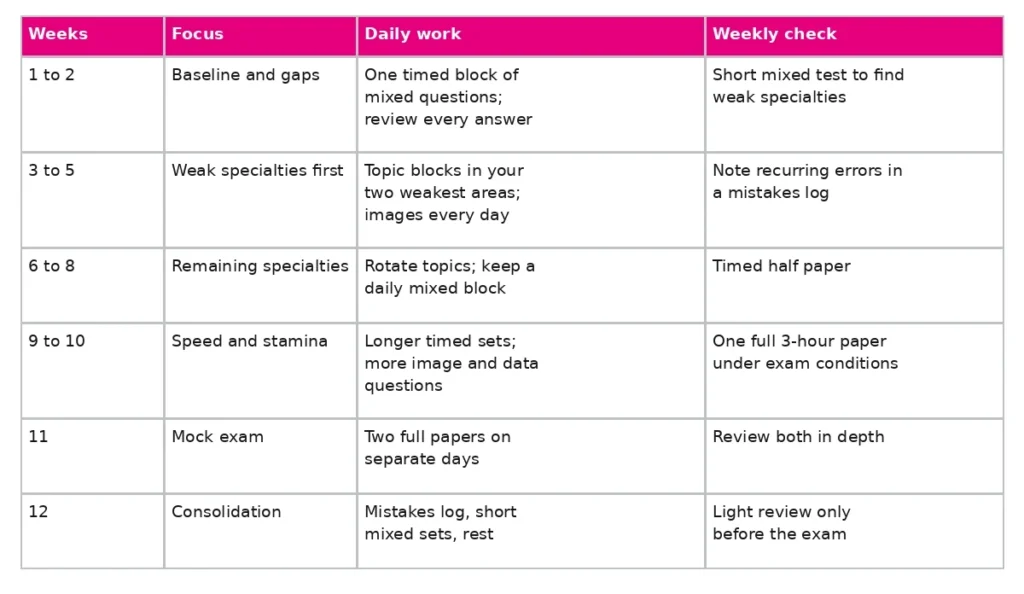
In any MRCP Part 2 preparation, the mistakes log matters more than any single resource. Each time you get a question wrong, write one line on why: missing knowledge, misread stem, or picked the second-best answer. By week 8 you will see your patterns clearly, and that is what you fix.
Data interpretation and image practice
Images and data are where many Part 2 Written candidates lose easy marks, so practise them every day rather than saving them for a special week. Part 1 had no images, while Part 2 questions can include them, and that switch catches people out.
Work on images the way you would on the ward. Look at the image first and describe what you see in your own words, then read the stem and decide whether the two fit together. Only then look at the options. This stops the answers steering what you think you are seeing.
Data works in a similar way. When a stem gives you a set of results, interpret them before reading the question: what is abnormal, what pattern does it fit, what would you do next? If you can say it aloud in two sentences, you understand it. If you cannot, that topic goes into your mistakes log.
A clinical reasoning approach to best-of-five questions
Every best-of-five question has one best answer, and usually one or two others that are reasonable. Your MRCP Part 2 preparation should train you to separate the best from the merely acceptable, quickly and consistently.
A simple method works well under time pressure:
- Read the last line first so you know what is being asked: diagnosis, next investigation or management.
- Read the stem and summarise the patient in one sentence.
- Predict the answer before you look at the options.
- Choose the option that fits this patient now, not the one that is generally true.
When you review, spend as much time on the questions you got right by luck as on the ones you got wrong. Ask why the best answer beat the runner-up. That single habit does more for your score than another hundred questions done in a hurry.
Remember the pace too. Each paper has 100 questions in 3 hours, which is under two minutes per question. Flag anything that takes too long and come back to it.
Turning ward work into revision
For MRCP Part 2 preparation, your ward work is your best revision resource, as long as you use it deliberately. The written exam rewards the kind of thinking you do when you clerk a patient, review results and decide on a plan.
Keep a small notebook or phone note during shifts. When you see an unfamiliar finding, an unusual result or a management decision you were unsure about, jot it down. That evening, do a short block of questions on the same topic. Linking a real patient to the questions makes the knowledge stick far better than reading in isolation.
If you are between posts or not doing acute medicine at the moment, take every chance to join ward rounds, read results and discuss cases with seniors. StudyMEDIC’s clinical programme in internal medicine is one option if you want structured clinical work alongside MRCP training.
Part 2 Written or PACES first?
You can take Part 2 Written and PACES in either order once you have passed Part 1, so the right choice depends on your situation. The regulations allow both routes, and neither is required first.
Many doctors take the written exam first because the revision follows on naturally from Part 1, and the knowledge base then helps in PACES. Others take PACES first when a seat comes up, especially internationally, where the Federation has acknowledged more candidates than places. If you are offered a PACES place, it may be worth taking it and returning to Part 2 afterwards.
There is no longer a seven-year limit to finish all parts, so you are not racing a clock. You do have a maximum of six attempts at each part, and a booked exam you miss counts as one. For the clinical side, read our guides to the MRCP PACES exam and MRCP PACES preparation.
The final weeks before the exam
In the last two weeks of MRCP Part 2 preparation, stop learning new topics and sharpen what you already know. Go through your mistakes log, do short mixed sets, and sit at least one full 3-hour paper so your concentration is used to the length.
In the final week, keep sessions short and protect your sleep. Check the practical details: the centre address, travel time and what you need to bring, which the Federation confirms before the exam. The exam is now computer-based in test centres, so arrive early and give yourself time to settle.
On the day, pace each paper, flag and move on, and do not let one hard question shake you. After the exam, rest. Results come out on a set date for each diet, and our MRCP results guide explains what to do next.
Frequently asked questions
How long does MRCP Part 2 preparation take?
Many working doctors allow around 12 weeks of focused study after passing Part 1. Adjust it to your rota, your baseline and how recently you sat Part 1.
Can I start preparing before my Part 1 result?
Yes. You cannot sit Part 2 Written until you pass Part 1, but there is nothing stopping you from starting your revision while you wait.
How should I practise images for Part 2?
Make images a daily part of your MRCP Part 2 preparation. Describe the image in your own words first, then match it to the stem before looking at the options.
Should I take Part 2 Written or PACES first?
Both orders are allowed after Part 1. Many take the written exam first, but if a PACES seat comes up it can make sense to take it.
How many questions should I do per day?
Aim for one timed block of Part 2 Written questions on most days and review every question in depth. Quality of review matters more than the raw number.
Does StudyMRCP offer a Part 2 course?
Yes. The MRCP Part 2 course, led by our course director Dr Suman Paul, offers structured teaching and question review.
Talk to our MRCP team about your plan, or explore the MRCP Part 2 course.